
Rrubber Material Specifications
Wrong Rubber Material, Premature Seal Failure? One Chart Has the Answer
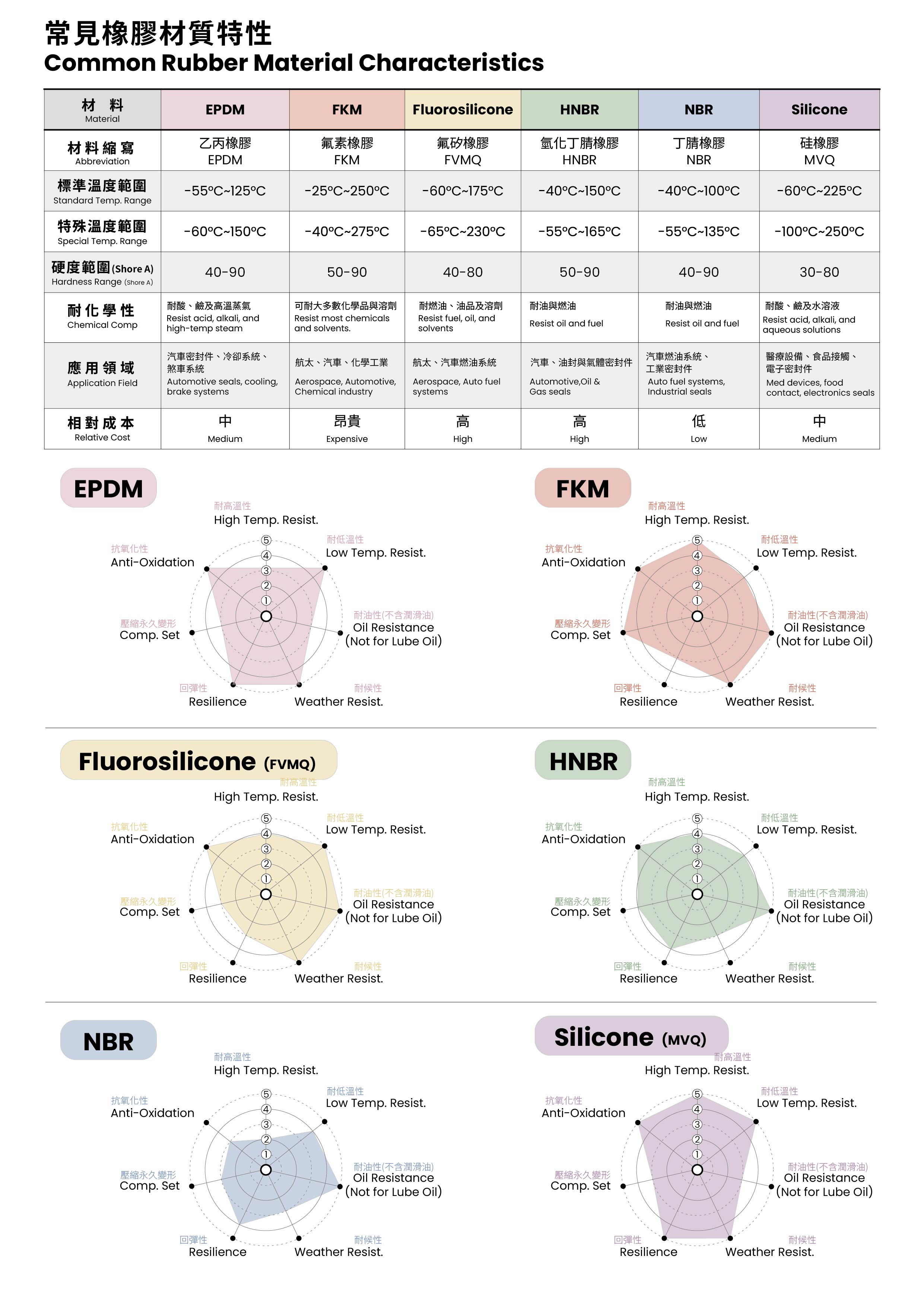
Complete Specification Overview for Six Mainstream Rubber Materials — Standard and Specialty Temperature Ranges, Hardness, Chemical Resistance, and Applications, with Radar Charts for Intuitive Seven-Property Comparison
Complex operating conditions and a wide range of available materials mean that a wrong selection translates directly into leakage, cracking, and premature replacement costs. NIYOK has compiled key performance data for six mainstream rubber materials — EPDM, FKM, Fluorosilicone (FVMQ), HNBR, NBR, and Silicone (MVQ) — paired with six performance radar charts that make differences immediately apparent, allowing engineers to confirm material selection before quoting and avoid repeated revisions.
Complete Performance Comparison for Six Rubber Materials — From Specification Tables to Radar Charts, Find the Right Match for Your Application.
Seal material selection is often where the most costly mistakes are made: temperature estimation errors, media incompatibility, and overlooked compression set can all cause an entire sealing assembly to fail ahead of schedule.
NIYOK has compiled data for six of the most commonly used rubber materials in the field — EPDM, FKM, Fluorosilicone (FVMQ), HNBR, NBR, and Silicone (MVQ) — presented in a structured specification table covering seven key parameters:
Standard Temperature Range: EPDM −55°C to 125°C / FKM −25°C to 250°C / FVMQ −60°C to 175°C / HNBR −40°C to 150°C / NBR −40°C to 100°C / MVQ −60°C to 225°C
Specialty Temperature Range: Specialty compounds can extend these limits further — FKM up to 275°C, MVQ down to −100°C on the low end
Hardness Range (Shore A): 30 to 90, covering soft to rigid applications
Chemical Resistance: From FKM's compatibility with most chemicals and solvents and FVMQ's resistance to fuels, to EPDM's resistance to acids, alkalis, and high-temperature steam — each material has its appropriate media
Application Fields: Automotive cooling systems, aerospace and chemical processing, oil seals and gas valves, medical, food, and electronics industries
Relative Cost: NBR at the lowest end, FKM at the highest, providing a basis for material selection across different budget requirements
Paired with six performance radar charts for intuitive comparison across seven dimensions — high-temperature resistance, low-temperature resistance, oil resistance, weather resistance, resilience, oxidation resistance, and compression set — engineers can quickly narrow down material options before procurement and reduce the risk of an incorrect selection.
Can't find a specification that fits your requirements? Contact NIYOK for a customized sealing solution.
- Download
rubber-material-specifications
Please download the latest rubber-material-specifications as follows. Our technical sales team has rich experience and technical expertise in O-rings and their...
Download