
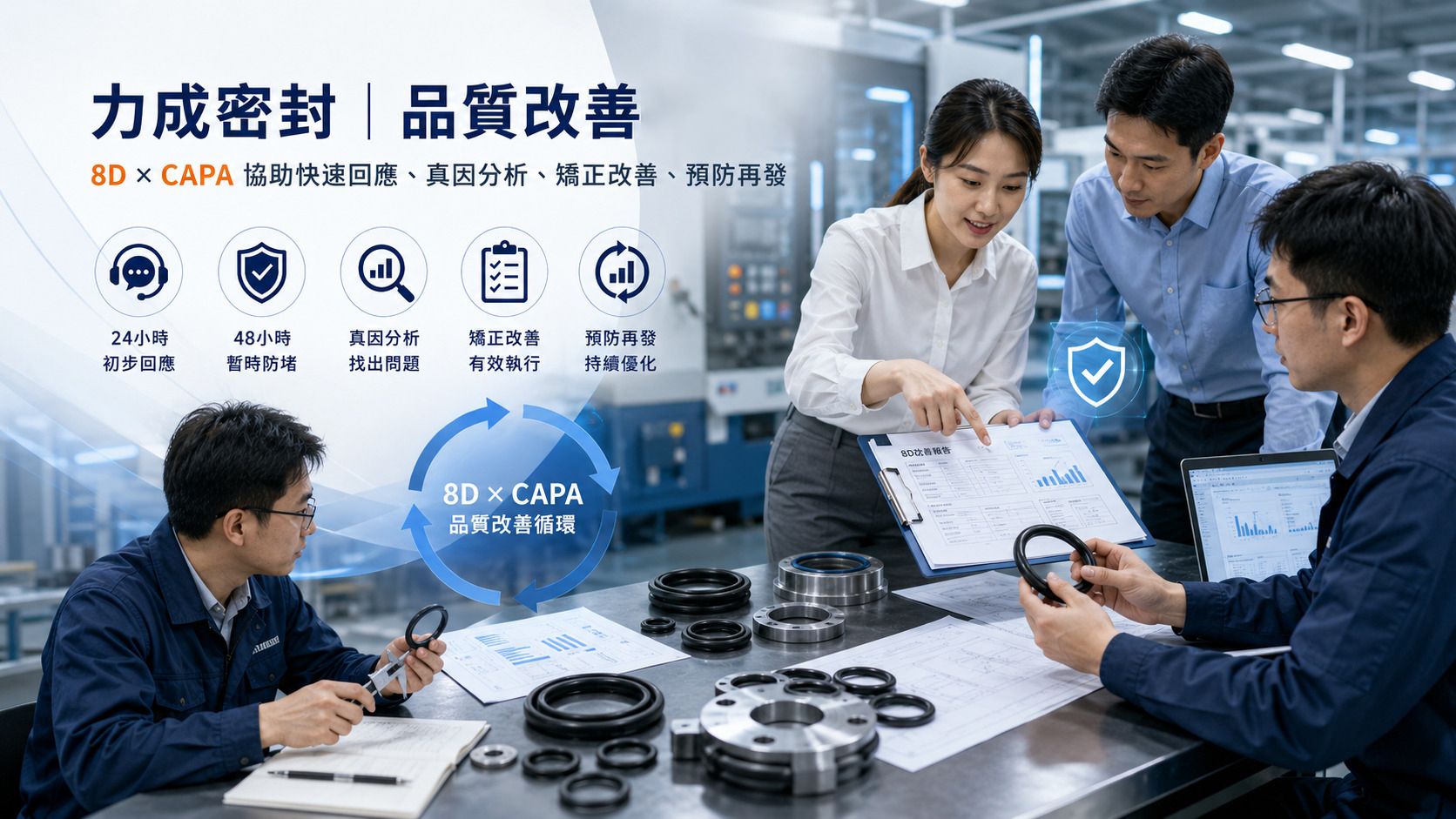
Quality-Improvement-Process
From Rapid Containment to Recurrence Prevention — NIYOK Reduces Quality Risk with 8D and CAPA
Systematic Process, Strengthened Customer Confidence.
NIYOK employs a systematic customer complaint handling process that integrates the 8D Problem-Solving Methodology and CAPA (Corrective and Preventive Actions) to establish a comprehensive quality management workflow — covering anomaly intake, initial assessment, temporary containment, root cause analysis, corrective implementation, and recurrence prevention. This enables customers facing quality issues or application concerns to follow a clear and traceable resolution process.
Rapid Response — Understanding the Problem and Requirements
When customers encounter specification anomalies, urgent requirements, installation issues, material application concerns, or on-site quality conditions, NIYOK follows a standardized process to confirm each case. For general cases, an initial response is provided within 24 hours to help clarify the issue, its scope, and urgency. Where immediate risk reduction is required at the customer's end, temporary containment measures are proposed within 48 hours to help stabilize production, maintenance, or development progress.

Root Cause Analysis and 8D / CAPA Improvement Reports
Once a problem has been brought under initial control, NIYOK conducts root cause analysis based on the nature and complexity of the case, and submits an 8D or CAPA improvement report as needed. The scope of analysis may include drawing specifications, material properties, process conditions, inspection standards, operating environments, installation methods, and product application conditions — ensuring that issues are not addressed only at a surface level, but that underlying causes are identified and corresponding corrective actions are established.

Cross-Functional Collaboration for Faster Problem Diagnosis
For urgent or complex cases, NIYOK can arrange on-site support as needed, with sales, engineering, manufacturing, and quality assurance teams working together to assess actual usage conditions. This cross-functional collaboration shortens the time required for information verification and problem diagnosis, making the resolution process more efficient and consistent.

Feeding Improvement Outcomes Back into Internal Management
Upon completion of corrective actions, NIYOK feeds customer feedback and anomaly resolution outcomes back into its internal management processes — including inspection checkpoints, process standards, operating procedures, and training content. Through continuous updates and standardization, this forms a closed-loop management mechanism spanning issue identification, temporary containment, root cause analysis, corrective action, and recurrence prevention.
Reducing Hidden Costs from Quality Anomalies
Through the 8D and CAPA quality improvement framework, NIYOK addresses not only individual anomaly events but also treats each case as a basis for process optimization and quality stabilization. This helps reduce the risks of line stoppages, rework, delivery delays, repeated anomaly communications, and recurring customer complaints — continuously strengthening the quality reliability of customized rubber components, sealing parts, and specialty material applications.
Reducing Quality Anomaly Risk Through 8D and CAPA Management
Through its systematic quality improvement process, NIYOK helps customers reduce the hidden costs associated with the following quality anomalies:
.Risk of Line Stoppages
.Probability of Rework
.Cost of Anomaly Communications
.Risk of Delivery Delays
.Probability of Recurring Customer Complaints
.Risk of Quality Anomaly Escalation