
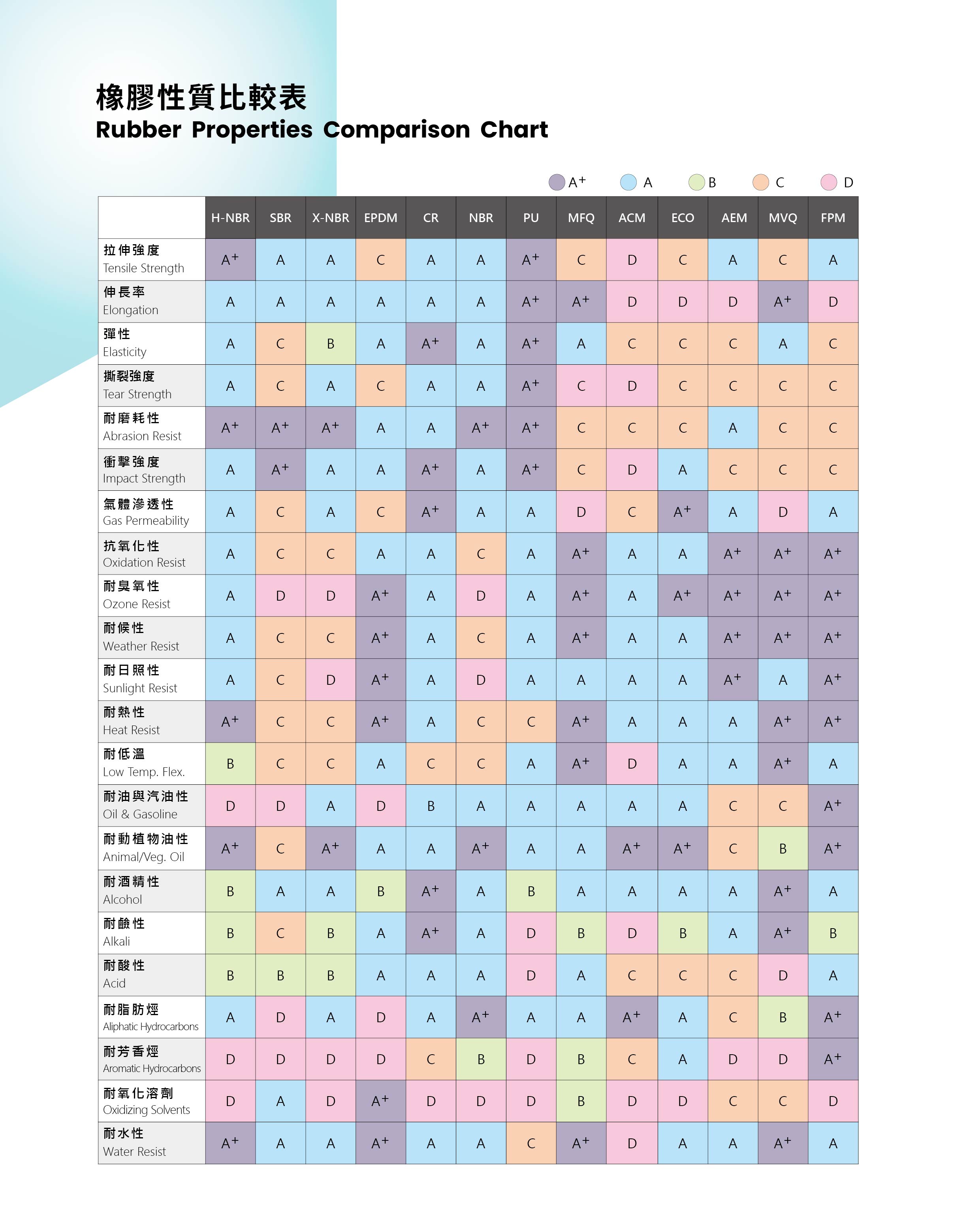
Rubber Properties Comparison chart
Relying on Intuition for Material Selection Means Paying for Future Failures
The wrong material choice makes even the most expensive seal a wasted investment. NIYOK has evaluated 13 mainstream rubber materials across 22 key performance properties — covering mechanical strength, environmental resistance, and media compatibility — using a five-level rating system from A⁺ to D. Engineers can see the real differences between materials in a single table without consulting multiple spec sheets, selecting the right material before quoting instead of guessing.
See the Real Differences Across 13 Rubber Materials in One Chart — No More Guesswork in Material Selection
Material selection seems straightforward — the pitfalls are usually in the details.
Both FPM and EPDM are categorized as "oil-resistant" materials, yet FPM achieves the highest A⁺ rating for oil and gasoline resistance while EPDM scores only D. If EPDM is mistakenly used in an application involving fuel contact, seal degradation is only a matter of time. This kind of gap cannot be identified through vendor recommendations or a single spec sheet alone — only transparent cross-material comparison makes it visible early.
NIYOK's Rubber Properties Comparison Chart consolidates data for 13 mainstream materials — H-NBR, SBR, X-NBR, EPDM, CR, NBR, PU, MFQ, ACM, ECO, AEM, MVQ, and FPM — rated across 22 performance properties on a five-level scale from A⁺ to D, covering:
Mechanical Strength: tensile strength, elongation, elasticity, tear strength, abrasion resistance, impact strength
Environmental Resistance: oxidation resistance, ozone resistance, weatherability, UV resistance, heat resistance, low-temperature resistance, gas permeability
Media Compatibility: oil and gasoline resistance, animal and vegetable oil resistance, alcohol resistance, alkali resistance, acid resistance, aliphatic hydrocarbon resistance, aromatic hydrocarbon resistance, oxidizing solvent resistance, water resistance
This allows engineers to make intuitive comparisons within a single table — without relying on any single vendor's claims — so material selection is evidence-based.
Yet material selection is only the starting point. Compound verification, life testing, process conditions, and tolerance compatibility — any one of these can cause an otherwise sound material choice to fall apart before mass production. NIYOK's dedicated R&D and quality assurance teams work alongside customers through every stage — from compound adjustment and mold design through sample validation and production quality control — helping to shorten development cycles and reduce the cost of trial and error.
The right direction for material selection, backed by a team that delivers — this is the most critical difference between NIYOK and suppliers who simply provide a catalog.
Can't find a specification that fits your requirements? Contact NIYOK for a customized sealing solution.
- Download
rubber-properties-comparison-chart
Please download the latest rubber-properties-comparison-chart as follows. Our technical sales team has rich experience and technical expertise in O-rings...
Download